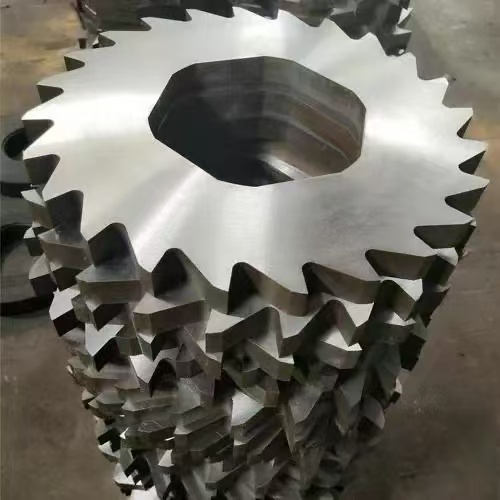
In industrial fields such as packaging, paper making, plastic recycling, non-woven fabrics, and food processing, industrial blades are core consumable parts. The selection of blade types directly determines production efficiency, cut quality, and material costs. Many factories encounter issues such as burrs, wire drawing, blade breakage, and frequent blade changes, which are essentially due to improper product category matching.
Currently, mainstream industrial blades can be categorized into four types, each suitable for different production scenarios. The first type is straight-edge slitting blades, which are commonly used for slitting soft materials such as films, paper, aluminum foil, and nonwoven fabrics. These blades feature a thin and sharp edge, making them ideal for high-speed and precise slitting conditions. The second type is round slitting blades, which rely on high-speed rotating cutting and are suitable for materials such as rubber, adhesive tapes, metal thin strips, and textile fabrics. Their specifications can be customized according to the inner and outer diameters and thickness required. The third type consists of crusher and shredder blades, which are made entirely of high-alloy materials, providing strong toughness and impact resistance. They are specifically designed for crushing operations involving plastics, rubbers, waste materials, and scraps. The fourth type is precision punching tooth blades, which are commonly used for micron-level precision processing of breathable films, packaging tear seals, medical nonwoven fabrics, etc., ensuring smooth and burr-free cuts.
Rationally matching blade categories can effectively reduce raw material waste and lower equipment downtime frequency, making it the simplest way for factories to reduce costs and increase efficiency.